
✨ Orton-Gillingham Method
Your child is brilliant. Let's unlock their full potential.
One-on-one, evidence-based tutoring for students with dyslexia, reading challenges, and neurodiversity. Personalized plans that create real, lasting progress — not quick fixes.
20+
Years Experience
Pre-K - 12
Grade Level
20+
Years Barton System

📖 Building confident readers, one student at a time
🧠
Science-Based
Orton-Gillingham Method
📈
Grade-Level Reading
Pre-K - 12
⚡ Does this sound familiar?
My child is so bright... why is reading such a struggle?
You’re not imagining it. Up to 20% of the population experiences significant difficulty learning to read. It’s not about effort — it’s about instruction.
😔
"He's just lazy" or "She'll catch up"
You’ve been told to wait. But your gut says something different. Research confirms: children who start behind rarely catch up without intervention.
📉
Falling Grades & Lost Confidence
Your child is getting quieter, more frustrated, avoiding homework. It’s not attitude — it’s a skill gap that’s snowballing.
🔄
Tutoring That Didn't Work
School support, reading specialists, private tutors — nothing stuck. That’s because most programs don’t target the root cause of phonological processing.
💡
Brilliant But Struggling
Your child amazes you with creativity and problem-solving, yet can’t read at grade level. Reading ability does not equal intelligence. Their brain just needs a different approach.
😫
Homework Is a Battle
What should take 20 minutes takes 2 hours. Both of you end up drained, frustrated, and dreading the next assignment.
🔍
Guessing Instead of Reading
Your child uses pictures, memorizes word shapes, and guesses based on context. These strategies collapse as material gets harder.
🎯 Our Approach
We target the root cause, not the symptoms
Most programs fail because they skip the foundation. We don’t.
1
Free Diagnostic Screening
We assess phonemic awareness, phonological memory and rapid naming using the CTOPP. We also administer the Gray Oral Reading Test which provides accurate measures of oral reading fluency and reading comprehension. Scores obtained on the GORT are standardized, valid, and reliable.
2
Build the Missing Foundation
After we look at your child's processing profile, we create a plan that fits your child's unique needs.
Many programs skip over the basics. This can lead to a weak foundation, where problems accumulate over time. As a result, children may feel frustrated, make little progress, and struggle to build real confidence because the basics were not adequately established.
3
Systematic, Multisensory Phonics
We use the Orton-Gillingham (OG) approach combined with our proprietary methods to ensure every student receives the depth of support needed to reach true automaticity. This structured, research-backed approach builds new neural pathways and strengthens how the brain processes language, helping students develop lasting, confident reading skills.
4
Track Real Progress
We conduct Dynamic Indicators of Basic Early Literacy Skills (DIBELS) assessments monthly and administer the Gray Oral Reading Test (GORT) every 6 months.
You don’t have to rely on promises; you see measurable progress in clear, objective data.

✅ Measurable progress every month

🏆 Why Every Kid Can Read?
Not every brain fits the mold.
We specialize in the ones that don't.
Here’s what actually makes us different — not marketing fluff.
🎯
Tailored Learning Plan
Not a one-size-fits-all curriculum. A custom plan built around your child’s specific learning profile, gaps, and strengths.
💛
Shame-Free Instruction
Empathetic, patient, engaging. We rebuild confidence alongside skills — because a kid who believes they can learn, will.
🧠
Orton-Gillingham / MSL Method
The gold standard for reading intervention. Proven to create new neural pathways that permanently change how the brain processes text.
📊
Measurable, Tracked Progress
Standardized assessments on a regular cadence. No guessing whether it’s working — you see the data.
📈
Lasting Results, Not Band-Aids
Concepts, rules, and strategies — not memorization. That means permanent improvement, not the “come-and-go” effect of typical tutoring.
🚀
Grade-Level and Beyond
Our goal isn’t coping. It’s helping your child reach grade-level proficiency and beyond.
💬 Real Results
Parents & Teachers See the Difference
These aren’t scripted reviews. These are turning points.
My happy son ‘disappeared’ when he realized he couldn’t read like the other kids. Despite being in a home full of books, nothing we tried worked. Now, thanks to your program, he’s finally learning! It has been the key to his confidence, his love for school, and his future success.
P
Parent of a 1st grader
I was volunteering in my son’s classroom today, and he actually raised his hand and volunteered to read out loud in class. I think he is beginning to have confidence in reading. Thank you to you both!
P
Parent of a 3rd grade
Our son is a smart kid who was struggling, and it was heartbreaking to hear him ask, ‘Why am I so dumb?’ Since starting Foundations Tutoring, (everykidcanread.com) the transformation has been remarkable. He is progressing and building real confidence. We finally feel he has the support he needs to chase his dreams.
P
Parent of a 1st grader
As both a mother and a pediatrician, I highly recommend Foundations Tutoring (everykidcanread.com). My 9-year-old son, diagnosed with dyslexia, made little progress with school interventions and was losing confidence. In just six months, he has already impressed his teachers with his growth! Their experienced instructors are knowledgeable, supportive, and true advocates for families. We feel very fortunate to have found this program.
P
Mom of a 3rd Grader
When we came to Foundations Tutoring (everykidcanread.com), my ten-year-old daughter was reading at a pre-K level. Within a year, her confidence and ability grew dramatically. Today, she’s a fluent reader who loves books and writing. Foundations didn’t just teach her to read—they helped her discover confidence and joy in learning.
P
Parent of a 4th grader
Foundations tutoring (everykidcanread.com) was the best decision we made for our son when he was struggling to learn to read. He was so far behind in kindergarten that he repeated that year along with starting the Barton reading program at Foundations. Looking back, it was a very tough time, but I am happy to say that he is now a sophomore at UC Berkeley doing a joint major in nuclear and electrical engineering.
P
Parent of a College Student
Foundations Tutoring (everykidcanread.com) has helped both of my children tremendously. Their team understands how kids who learn differently need to be taught, and I’ve watched my children grow in reading and confidence. Now I catch them reading whenever they have a free moment. I highly recommend Foundations.
P
Parent of two elementary-aged girls
⚠️ Know the Signs
When Should You Be Concerned?
Research is clear: children who get off to a poor start in reading rarely catch up on their own. Early intervention is everything.
🐢 Reads slowly, laboriously, or frequently stops and repeats words
🔀 Changes small words, skips words, or adds words that aren't there
🖼️ Uses pictures to guess at words instead of sounding them out
✏️ The student is able to memorize words for a spelling test, but often has trouble remembering or using them correctly later on.
😩 Tires easily when reading — accuracy declines over time
🙈 Avoids reading aloud, dreads homework, or has become the "class clown"
📖 Understands everything read TO them but struggles with silent reading comprehension
Don't Wait for "Catching Up"
If help starts in 4th grade instead of kindergarten, it takes 4x as long to improve the same skills. The earlier you act, the better the outcome.
❓ Common Questions
Frequently Asked Questions
First Questions Answered
Understanding Reading Difficulty and Why Your Child May Struggle
Can you help my child?
In most cases, yes.
Our program is designed for children whose reading progress does not match their intelligence, effort, or curiosity. Many of the families who contact us describe children who are bright, articulate, and thoughtful, yet reading feels unusually hard.
If your child reads slowly, guesses at words, struggles with spelling, avoids reading, or is not making steady progress despite practice or school support, these are strong indicators that they may need instruction that is different from what is typically provided in a classroom setting.
Our role is to determine whether your child’s difficulty is rooted in how they are processing the sounds of language, and to provide instruction that directly addresses that need.
Why is my child working so hard to read?
Children who struggle with reading often rely on inefficient strategies because they do not yet have reliable tools for decoding words.
Instead of automatically connecting letters to sounds, they may try to memorize words, guess based on pictures or context, or rely on the overall shape of a word. These strategies can help a child get through easier text for a while, but they require enormous mental effort and are not sustainable as reading becomes more complex.
You may notice frequent self corrections, skipped or substituted words, reading that feels rushed or exhausting, or a child who understands text well when it is read aloud, but struggles when reading independently.
Our instruction replaces these inefficient strategies with accurate decoding. Decoding means sounding out words by consistently connecting letters to their corresponding sounds. When decoding becomes accurate and automatic, reading requires far less effort and becomes smoother, faster, and more enjoyable.
How do I know when to be concerned? Isn’t reading developmental?
It is true that children develop at different rates. However, reading is not a naturally developing skill in the way spoken language is. The brain must be explicitly taught how to connect written symbols to spoken sounds.
Research consistently shows that children who struggle with early reading skills rarely catch up on their own without specialized instruction. Waiting does not usually resolve the underlying difficulty, and gaps tend to widen over time.
Early signs that warrant attention include difficulty learning letter sounds, slow or effortful reading, guessing instead of sounding out words, weak spelling, or frustration and avoidance around reading.
Trusting your instincts and seeking clarity early can prevent years of unnecessary struggle.
Is reading difficulty the same as dyslexia?
Not always.
Dyslexia is a specific, language based learning difference that affects how the brain processes the sounds of spoken language and connects them to print. Children with dyslexia typically have persistent difficulty with decoding, spelling, and reading fluency, despite adequate instruction and effort.
Other children who have reading challenges, may struggle with reading due to limited instruction, inconsistent exposure, attention challenges, or gaps caused by school disruptions. Dyslexia is one type of reading difficulty, but not all reading difficulty is dyslexia.
Understanding the underlying cause helps guide expectations, but the type of instruction needed is often similar.
How do I know if my child has dyslexia?
Dyslexia often shows up as a pattern rather than a single symptom.
Children with dyslexia frequently struggle to sound out unfamiliar words, read slowly or inaccurately, and have ongoing difficulty with spelling. These challenges persist even when the child is bright, motivated, and receiving typical classroom instruction.
Dyslexia often runs in families and may co-occur with attention challenges, speech or language delays, dysgraphia, or dyscalculia.
A formal diagnosis can be helpful, but it is not required to begin effective instruction. What matters most is whether reading is harder for your child than it should be.
What warning signs make dyslexia more likely?
Certain patterns increase the likelihood that dyslexia is contributing to a child’s reading difficulty.
These include strong reasoning and listening skills paired with weak reading, significant difficulty with phonemic awareness, persistent trouble sounding out words, slow effortful reading despite practice, frequent spelling errors, or a family history of reading struggles.
Phonemic awareness refers to the ability to hear, identify, and work with the individual sounds in spoken words. This skill is a critical foundation for learning to read, and weakness in this area is common in dyslexia.
What exactly is dyslexia?
Dyslexia is a language based learning difference that affects reading and spelling. It is not caused by low intelligence, lack of effort, or poor motivation.
Children with dyslexia often think deeply, reason well, and have strong oral language skills, but they need explicit instruction to build accurate and automatic decoding.
With the right instruction, children with dyslexia can become confident, capable readers.
How common is dyslexia?
Research suggests that approximately one in five children show signs of dyslexia or significant reading difficulty.
Many are not identified early because they compensate well, or appear to be on grade level while working much harder than their peers. Early intervention helps prevent frustration and long term academic consequences.
What should I do if I suspect dyslexia?
If reading feels harder than it should be, it is appropriate to seek clarity.
An assessment can help determine whether your child’s difficulty is related to phonological processing, decoding, fluency, or comprehension, and can guide decisions about instruction.
You do not need to wait for a diagnosis to take action.
Does it matter whether the difficulty is dyslexia or something else?
Understanding the cause helps set expectations, but the instructional response is often the same.
Children with reading difficulty benefit from explicit, systematic instruction that teaches reading skills directly and to mastery. Children with dyslexia may require more repetition and time to build full fluency, but the instructional approach remains consistent.
The most important factor is receiving the right type of instruction early.
Can dyslexia affect comprehension?
Yes.
When a child must devote most of their mental energy to sounding out words, little energy remains for understanding and remembering what they read. This is why some children comprehend well when listening, but struggle when reading independently.
As decoding and fluency improve, comprehension typically improves as well.
Why do schools sometimes say my child is fine when I feel something is wrong?
Bright children often compensate in early grades, and benchmark assessments may not capture subtle weaknesses in decoding.
Schools may also wait for a child to fall significantly behind before intervening. Parents often notice early signs of struggle long before schools raise concerns.
Your observations are important and valid.
Does waiting make reading difficulty worse?
Yes.
Without appropriate instruction, reading gaps tend to widen over time. Confidence decreases, reading becomes more effortful, and children may begin to associate reading with failure or frustration.
Early intervention leads to faster progress and better long term outcomes.
Is dyslexia inherited?
Yes.
Dyslexia often runs in families. A history of reading or spelling difficulty in parents or close relatives increases the likelihood that a child may face similar challenges.
Can vision problems cause dyslexia?
No.
Dyslexia is a language processing difference. While vision issues can affect comfort during reading, they do not cause dyslexia and do not resolve reading difficulty.
Can my child benefit from your program even if the school has not identified them?
Absolutely.
Many children need support before they qualify for school services. School identification is not a prerequisite for effective intervention.
Is it too late to help an older student?
No.
Older students often make meaningful progress once they receive instruction that directly addresses their underlying reading difficulty. Improvement is possible at any age.
When should I request a complimentary consultation and assessment?
If your child struggles with decoding, spelling, fluency, confidence, or progress despite effort or school support, an assessment can provide clarity and direction.
Complimentary Consultation and Reading Assessment
Understanding What the Assessment Is and What It Is Not
What is the complimentary consultation and reading assessment?
The complimentary consultation and reading assessment is a no cost way to understand why reading feels difficult for your child, and whether specialized instruction would be helpful.
It is not a placement test, and it is not a pass or fail evaluation. Its purpose is to look carefully at the underlying skills that support reading, rather than relying only on grades, reading level labels, or surface performance.
Parents often tell us they already know their child is struggling. The assessment helps clarify what is driving that struggle, and what type of instruction is most likely to help.
What does “complimentary” mean? Is there an obligation?
Complimentary means free.
There is no cost and no obligation to enroll. Our goal is to provide clarity so parents can make informed decisions about how to support their child.
We believe parents make the best decisions when they understand what is actually happening.
What do you mean by looking beneath surface performance?
Surface performance refers to things like report card grades or reading level labels that may hide underlying difficulty.
Some children appear to be doing fine on paper while working much harder than they should. Others have learned to compensate by guessing or memorizing.
Looking beneath surface performance means examining how your child processes sounds, connects letters to sounds, reads unfamiliar words, and reads connected text. This allows us to understand whether reading difficulty is rooted in foundational skill gaps.
What skills do you assess?
We assess the core skills that research shows are critical for learning to read successfully. These include phonological processing, decoding, reading fluency, and comprehension.
Phonological processing involves how the brain works with the sounds in spoken language. Weakness in this area is one of the most common underlying causes of dyslexia and persistent reading difficulty.
By assessing these skills directly, we can see where breakdowns are occurring, and which areas need targeted instruction.
What kinds of tools do you use?
We use standardized, research validated assessment tools that are commonly included in comprehensive reading and learning evaluations.
These tools provide reliable information about how your child is processing language and reading, rather than relying on informal observation alone. They help us distinguish between children who need more practice, and those who need different instruction.
Results are explained in plain language so you understand what they mean for your child, not just how they compare to a score.
How is this different from a school screening or classroom assessment?
School screenings are designed to identify risk across large groups of students. They are important, but they are brief and limited in what they measure.
Our assessment is individualized and diagnostic. It looks more deeply at the specific skills involved in reading and how they interact for your child. This allows us to explain why a child is struggling, not just whether they are below a benchmark.
Both types of assessment are valuable, but they serve different purposes.
Will you tell me if my child has dyslexia?
We can identify patterns that are consistent with dyslexia, and explain whether your child’s profile fits what is commonly seen in dyslexic learners.
We do not provide medical or school diagnoses. However, many families find that understanding the pattern of strengths and weaknesses is far more helpful than a label alone when deciding what to do next.
What happens after the assessment?
After the assessment, we meet with you to clearly explain the results and answer your questions. We discuss what is contributing to your child’s reading difficulty and what type of instruction would be most appropriate.
You will receive a copy of your child’s test scores for your records, along with a clear explanation of what they mean. While we do not provide a formal written report, families leave this meeting with a strong understanding of their child’s reading profile and next steps.
If our program is a good fit, we will explain what that would look like so you can decide how you would like to proceed.
Why do you offer this assessment at no cost?
We offer the assessment because reading difficulty is often misunderstood, and delayed support can have long term consequences.
Providing clear information early helps families avoid years of frustration, unnecessary tutoring, or waiting for problems to resolve on their own. We believe clarity is a service in itself.
When should I request a consultation and assessment?
You should request a consultation if reading feels harder for your child than it should be.
This includes children who guess at words, read slowly, struggle with spelling, avoid reading, show frustration or anxiety around schoolwork, or are not making steady progress despite effort or support.
You do not need to wait for a diagnosis, a failing grade, or a school referral to seek clarity.
What Reading Difficulty Looks Like
Reading difficulty does not look the same for every child. Some children struggle early and visibly. Others work very hard to compensate and appear “fine” until reading becomes more demanding in later grades.
Many parents sense that something is off long before the school raises concerns. This section helps you understand what reading difficulty can look like academically, emotionally, and behaviorally, so you can make informed decisions about support.
Why do bright, articulate children sometimes struggle with reading?
Even very bright children can struggle with reading because reading relies on specific language processing skills that are separate from intelligence.
Many children with reading difficulty have strong reasoning, creativity, and listening comprehension. They may speak well, understand complex ideas, and ask thoughtful questions. However, reading requires the brain to connect sounds to letters quickly and automatically. For some children, these underlying skills do not develop easily without specialized instruction.
As a result, sounding out words takes tremendous effort. Reading is slow and tiring. Comprehension suffers because so much mental energy is spent decoding words. School performance may not reflect the child’s true potential.
This mismatch between intelligence and reading skill is often confusing for parents. It is also one of the clearest signs that a child needs a different type of reading instruction.
Are children with dyslexia intelligent?
Absolutely.
Research shows that dyslexia occurs across the full range of intelligence, including average, above average, and gifted learners. Dyslexia is not an intelligence problem. It is a language processing difference that affects how the brain connects sounds to written words.
Many dyslexic learners show strengths in reasoning, problem solving, creativity, storytelling, empathy, and big picture thinking. A child can be very bright and still struggle to read.
With explicit Orton Gillingham instruction that teaches reading step by step, children can become confident, capable readers whose performance reflects their true ability.
Why does my child guess at words instead of sounding them out?
Guessing is one of the most common signs of reading difficulty.
Children guess when sounding out words does not feel reliable. Instead of confidently using letter sounds, they may rely on pictures, context, memory, the first letter of a word, or what seems to make sense in the sentence.
These strategies may help a child get through simple books in the early grades, but they break down quickly as texts become longer and more complex. Guessing leads to errors, slow reading, and frustration.
Guessing is a sign that a child has not yet developed strong, automatic decoding skills. When sounding out words does not feel reliable, children look for other ways to get through text.
Guessing is not a behavior problem and it is not laziness. It reflects a skill gap, not a motivation problem.
Why is fluent, smooth reading so difficult for some children?
Fluent reading requires three things working together: accurate decoding, automatic word recognition, and efficient processing so reading sounds natural.
Many struggling readers can decode words accurately after support, but fluency still lags because each word requires conscious effort. Automatic reading takes many correct repetitions over time. When decoding is slow or effortful, the brain has less energy available for expression and comprehension.
This is why reading may sound choppy, monotone, or rushed, even when the child knows the words. Fluency develops gradually as decoding becomes automatic, not all at once.
My child reads the words correctly but forgets what they just read. Why?
This is very common.
Many children have strong listening comprehension but weak reading comprehension because reading takes so much effort. When a child must focus intensely on sounding out words, there is little mental energy left for understanding and remembering what the text means.
Parents often notice that their child understands stories perfectly when they are read aloud, but struggles to explain what they read independently. This is not a comprehension weakness in the usual sense. It is a decoding and fluency issue.
As identifying words on the page becomes more automatic, comprehension typically rises to match the child’s true thinking ability.
Why does my child read a word correctly on one page but miss it later?
Inconsistent reading is a key indicator of reading difficulty.
This happens when words are not yet firmly stored in long term memory. A child may recognize a word one moment and struggle with it the next because they are relying on memory or context rather than automatic decoding.
Strong readers recognize words instantly and consistently. Struggling readers need repeated, accurate practice across many contexts before word recognition becomes reliable.
Why is spelling so difficult for my child?
Spelling is often harder than reading for children with reading difficulty.
Spelling requires strong awareness of sounds in words, accurate sound to letter mapping, correct sequencing, and knowledge of spelling patterns. Many struggling readers spell the same word several different ways, leave out sounds, confuse vowels, or reverse letter order.
These difficulties are not carelessness. They reflect weaknesses in the same underlying skills that affect reading. When spelling is taught explicitly and systematically, it often improves dramatically alongside reading.
Why does my child's writing look much weaker than his oral language and ideas?
Writing is one of the most demanding academic tasks.
To write, a child must juggle spelling, handwriting or typing, grammar, sentence structure, organization, and ideas all at once. For a child with reading or spelling difficulty, this creates overload.
Many bright children have excellent ideas but struggle to get them onto paper. Writing may be short, vague, or incomplete, not because the child lacks ideas, but because so much effort is required to manage the mechanics.
With explicit instruction in spelling, sentence structure, and organization, writing often becomes clearer, longer, and more confident.
What emotional or behavioral signs are associated with reading difficulty?
When reading is harder than it should be, children often develop secondary emotional or behavioral responses.
These may include avoiding reading or writing, pretending not to care, frustration or tears during homework, perfectionism, stomachaches before school, anger at home, low confidence, or statements like “I’m dumb” or “I hate reading.”
These reactions are not personality traits. They are signs of chronic academic stress. When children begin to experience consistent success, these emotional symptoms often improve quickly.
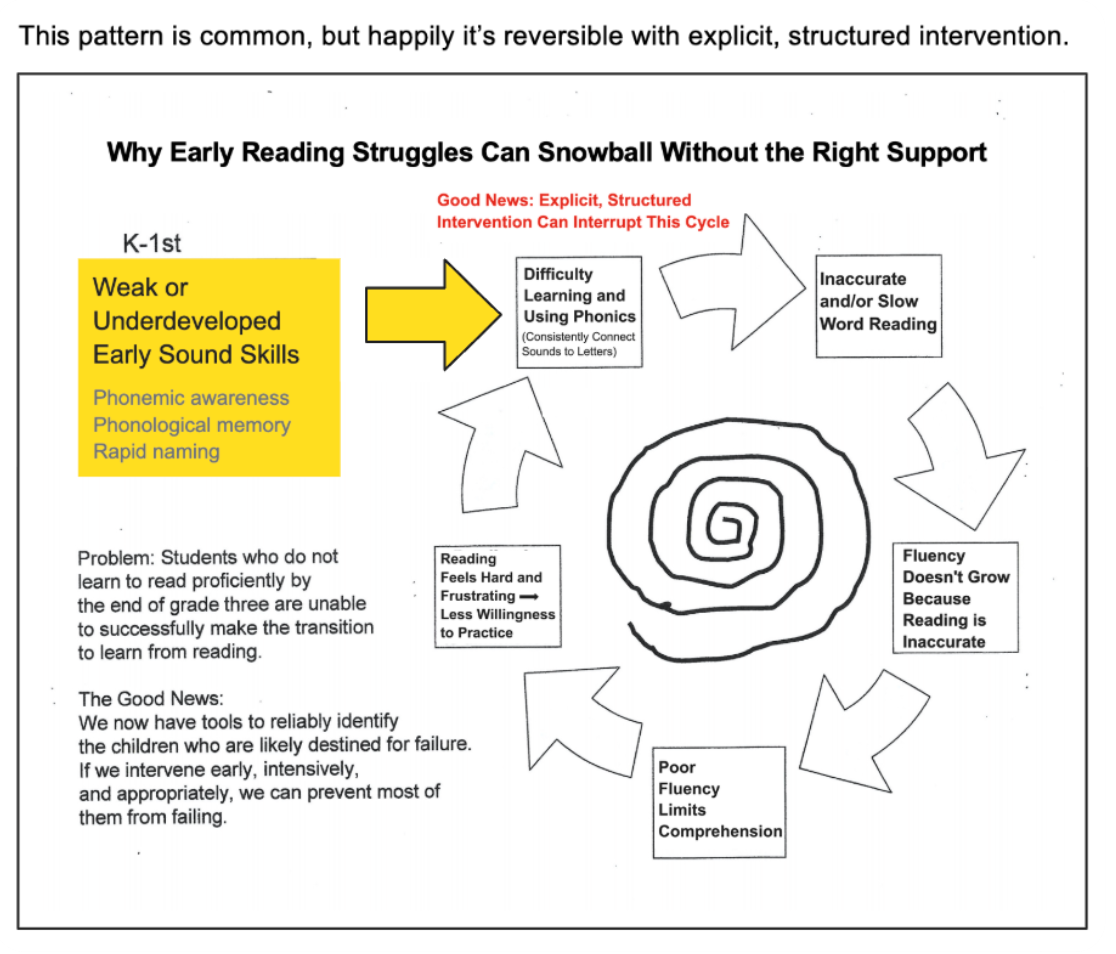
What does reading difficulty look like in kindergarten and first grade?
Early signs may include difficulty learning letter names or sounds, trouble rhyming, problems blending sounds into words, guessing instead of sounding out, forgetting words from day to day, avoiding simple early reading books that classmates are reading independently, or strong listening comprehension paired with weak reading.
Early identification matters. Children who receive support in kindergarten or first grade make faster and more lasting progress than those who wait.
What does reading difficulty look like in older students?
In older students, reading difficulty often looks different.
Signs may include slow, effortful reading, weak spelling, difficulty with longer or unfamiliar words, trouble summarizing written text, avoidance of novels or long assignments, short or vague writing, taking much longer than peers to complete homework, and surprisingly strong understanding when listening, even though reading remains slow or effortful.
Many older students have learned to mask their struggles. They may be described as careless, unmotivated, or not trying, when in reality reading is still not automatic.
Why do schools sometimes miss reading difficulty or say my child is fine?
Several factors make reading difficulty easy to overlook.
Bright children compensate well. Some programs emphasize guessing strategies that hide decoding weaknesses. Students who are just below grade level may not qualify for extra help. Fluency and comprehension problems often appear later. School testing may not assess underlying skills.
Parents often notice concerns long before schools do. Trusting your instincts is important.
Do children with dyslexia have strengths?
Yes.
Many dyslexic learners have significant strengths alongside their reading challenges. These strengths may include creativity, problem solving, reasoning, empathy, leadership, resilience, and big picture thinking.
Understanding strengths does not minimize reading difficulty. It helps families see the whole child. Section 5 explores this in greater depth.
Understanding Dyslexia And The Science Of Reading
What dyslexia is, what it is not, and what decades of research tell us about how children learn to read.
Reading is not a natural process. Children are born wired to speak and understand language, but they are not born knowing how written language works. Learning to read requires the brain to build new connections between sounds and letters through instruction.
This section explains what dyslexia really is, why reading difficulty does not resolve on its own, and why the type of instruction a child receives matters so much.
What exactly is dyslexia?
Dyslexia is a language based learning difference that makes learning to read and spell harder than expected, even when a child is bright, curious, and motivated.
Children with dyslexia have difficulty accurately and fluently identifying written words. Spelling and writing are often affected as well. These challenges are unexpected because the child’s thinking, reasoning, and listening skills are typically age appropriate or above average.
Dyslexia is not caused by low intelligence, lack of effort, or poor parenting. It reflects how the brain processes the sounds in language and connects those sounds to print.
With the right instruction, children with dyslexia can become strong, confident readers and writers.
Are dyslexia and reading difficulty the same thing?
Not always.
All children with dyslexia experience reading difficulty, but not all reading difficulty is dyslexia. Some children struggle to read because of gaps in instruction, inconsistent schooling, limited early literacy exposure, attention challenges, or other learning differences.
Dyslexia is different because it is rooted in phonological processing. This refers to the brain’s ability to identify, remember, and manipulate the sounds within words. When these skills are weak, reading and spelling do not become automatic without specialized instruction.
Because early reading difficulty and dyslexia can look very similar, many children need the same type of instruction regardless of whether a diagnosis has been made.
Is dyslexia inherited?
Yes. Dyslexia often runs in families.
Research shows that if a parent, sibling, or close relative struggled with reading or spelling, a child has a higher likelihood of experiencing similar challenges. Genetics play a significant role, although dyslexia involves multiple genes and differences in brain development rather than a single identifiable cause.
A family history of reading difficulty is an important early indicator and one reason early screening and intervention matter.
Are children with dyslexia intelligent?
Absolutely.
Dyslexia occurs across the full range of intelligence, including average, above average, and gifted learners. Brain imaging studies consistently show that dyslexia reflects differences in how language is processed, not differences in intelligence.
Many dyslexic learners show strengths in reasoning, creativity, oral language, problem solving, empathy, and big picture thinking. A child can be exceptionally bright and still struggle to read.
Dyslexia affects how reading is learned, not how capable a child is.
Can vision problems, tracking issues, or colored overlays treat dyslexia?
No.
Dyslexia is not caused by vision problems or visual tracking issues. Major medical and educational organizations agree that dyslexia is a language processing difference, not a visual disorder.
Some children may also experience eye strain or visual discomfort when reading, and addressing those issues with tracking exercises or colored overlays may improve comfort. However, vision therapy does not treat dyslexia or resolve reading difficulty rooted in language processing.
Effective intervention focuses on teaching how written language connects to spoken language.
What is the Science of Reading and why does it matter?
The Science of Reading refers to decades of research from cognitive psychology, linguistics, neuroscience, and education that explains how the brain learns to read and which instructional methods are most effective.
Key findings from this research include:
Children must be explicitly taught how written language works.
Strong reading depends on accurate decoding and phonological skills.
Fluency and comprehension depend on automatic word recognition.
Effective instruction is explicit, systematic, cumulative, and responsive to student progress.
Instruction aligned with this research is far more effective for struggling readers than approaches that rely on guessing, memorization, or exposure alone.
What makes Orton Gillingham instruction different?
Orton Gillingham is an instructional approach designed specifically for students who struggle to learn to read and spell.
It teaches reading and spelling step by step, in a carefully planned sequence. Each skill is taught explicitly, practiced until it is mastered, and continually reviewed so learning becomes automatic.
Unlike many classroom programs, Orton Gillingham instruction does not assume that children will pick up patterns on their own. Nothing is left to chance. Instruction is diagnostic, meaning it responds to how the child is learning in real time.
This approach directly targets the underlying language skills that make reading difficult for children with dyslexia and other reading challenges.
Why do some children learn to read easily while others need explicit instruction?
Some children naturally develop strong phonological and word recognition skills with minimal instruction. Their brains quickly form the connections needed for reading.
For children with dyslexia or significant reading difficulty, these connections do not form easily through regular classroom instruction alone. When sound–letter relationships are not firmly established, word reading feels unreliable and automaticity takes much longer to develop. As a result, many children adapt by trying to memorize words instead. While this may work briefly, memorization is an inefficient and unreliable long-term strategy for reading.
These children need instruction that teaches reading explicitly and systematically, ensuring the brain builds the correct pathways for reading. Without this type of instruction, progress is often slow or inconsistent.
Why does early intervention matter so much?
Reading difficulties do not resolve with time alone.
Research shows that children who struggle with reading in the early grades rarely catch up without specialized instruction that directly teaches decoding and language structure. Waiting until later grades often means it takes much longer to close gaps and confidence will likely suffer along the way.
Early intervention is powerful because the brain is more flexible, inefficient habits have not yet become ingrained, and children experience success before frustration builds.
That said, it is never too late to improve reading with the right instruction.
What strengths are commonly associated with dyslexia?
Dyslexia often involves a specific weakness in phonological processing surrounded by a wide range of strengths.
Many dyslexic learners show strong reasoning skills, creativity, oral language, problem solving, empathy, and resilience. These strengths often become even more visible once reading barriers are addressed.
Understanding both the challenges and the strengths helps families support the whole child, not just reading skills. Section 5 explores this strength-based perspective in greater depth.
Our Program
How we teach, why it works, and what makes our instruction different.
Parents often know that their child is struggling long before they understand why reading feels so hard. This section explains how our program works, why it leads to lasting progress, and how it differs from typical school support or tutoring.
What does your program include?
We provide one on one Orton-Gillingham reading and spelling instruction for students in grades K through 12, delivered virtually through an interactive online workspace.
Orton-Gillingham is a research-based approach that explicitly teaches how written language connects to spoken language, one carefully sequenced step at a time, with practice built in until skills become automatic.
Every student in our program receives:
A highly trained tutor
Instruction is delivered by a tutor trained to teach reading and spelling explicitly, systematically, and responsively, based on how your child learns.
Program oversight and support
Behind every tutoring session is a manager that monitors progress, supports lesson planning, and ensures instruction is delivered with fidelity and precision.
Ongoing progress monitoring
We regularly review data and student performance to confirm your child is improving at the pace needed to close gaps and build fluency.
Clear communication with parents
We believe parents deserve transparency. You will understand what your child is learning, how they are progressing, and what comes next.
Our goal is not short-term improvement. It is permanent, automatic reading and spelling skills.
How is your instruction different from other reading programs or tutoring?
Many programs describe themselves as structured, research based, or evidence informed. However, these labels alone do not tell you how reading is actually being taught.
Our instruction is different because it is:
Explicit
Skills are taught directly. Nothing is assumed or left to discovery.
Systematic and sequential
Reading and spelling are taught in a carefully planned order, from simple to complex, so gaps do not form.
Cumulative
Previously taught skills are continually reviewed and applied so learning is retained and becomes automatic.
Diagnostic and responsive
Instruction is adjusted in real time based on your child’s responses and error patterns.
Most importantly, instruction continues until skills are accurate, fluent, and automatic. We do not move a child forward simply because time has passed. We go forward as fast as we can, and as slow as we must to insure your child’s mastery.
How is your instruction different from the extra help my child receives at school?
School-based reading support is often delivered in small groups, follows a set curriculum pace, and is limited by time and staffing. While these supports can help some students, they are not always intensive or individualized enough for children who struggle to learn to read easily.
Our instruction differs in several important ways:
One-on-one instruction
Your child receives individualized attention in every session. Instruction is never diluted by group pacing or competing needs.
Specialized reading instruction
We use Orton–Gillingham instruction, a structured, research-based approach designed specifically for children who do not learn to read through typical classroom methods.
Enough accurate practice to build automaticity
Fluency develops through repeated, accurate decoding of words and patterns your child has been taught. This is different from repeated reading of uncontrolled text, which often reinforces guessing or memorization rather than building real reading skill.
Mastery-based progression
Instruction does not move forward because time has passed or a lesson has been completed. Skills are taught until they are accurate, fluent, and automatic. We move as quickly as your child is ready and as slowly as needed to ensure true mastery.
Ongoing monitoring and adjustment
Instruction is continuously adjusted based on your child’s performance. If a skill is not sticking, we pause, reinforce, and reteach rather than pushing ahead.
The goal is not short-term improvement or coping strategies. The goal is to build the underlying skills that allow reading and spelling to become reliable, automatic, and sustainable over time.
How does your program lead to lasting progress?
Lasting progress comes from how skills are taught and practiced.
We ensure progress by:
Teaching skills to mastery
Mastery develops in stages. Accuracy comes first. With enough correct, controlled practice, accuracy becomes fluent and automatic. Only then is a skill truly mastered.
Providing sufficient repetition
Skills are practiced across word lists, sentences, and connected text so they become automatic.
Building generalizable knowledge
Students learn patterns and rules that apply to many words, not just the ones they practiced.
Monitoring progress continuously
If progress slows, instruction is adjusted immediately.
Your child is not memorizing words. They are learning how the language works.
How do you monitor my child’s progress?
We use a combination of standardized progress monitoring and ongoing instructional checks.
This allows us to answer important questions clearly:
- Is your child improving?
- Is progress fast enough to close gaps?
- Are skills becoming automatic?
- Does instruction need to be adjusted?
You will not be asked to rely on reassurance alone. Progress is visible and measurable.
Why does one on one instruction matter so much for struggling readers?
Struggling readers need immediate feedback, precise correction, and individualized pacing.
In one on one instruction:
- Errors are addressed right away
- Practice is adjusted moment by moment
- No time is spent waiting or watching others
- Instruction matches the child, not the group
Group instruction, even when well designed, cannot provide this level of precision.
Can children really learn to read and spell effectively online?
Yes. Our virtual model preserves all essential elements of effective Orton-Gillingham instruction.
Students actively:
- Manipulate letters and word parts
- Break words into sounds and syllables
- Read, write, sort, and respond verbally
- Engage continuously with the material
The student is doing the work, not watching the tutor work.
Many students focus better online because distractions are reduced, lessons are structured, and interaction is constant.
How does virtual tutoring help parents stay involved?
Virtual instruction gives parents more visibility than traditional tutoring.
Parents can:
- See the materials used in lessons
- Understand what skills are being taught
- Observe growth over time
- Support their child with confidence
Parents gain clarity about what their child is ready to read/decode and what they are not yet prepared to handle. This helps families reduce frustration, avoid reinforcing guessing habits, and support reading at home in a way that protects progress.
Families often tell us they finally understand how reading works and why their child has been struggling.
Why does my child practice reading words they don’t seem to know yet?
Some of the words your child practices may sound unfamiliar at first, and that is expected. At this stage, the goal is to build accurate decoding, not to require full understanding of every word right away.
Reading is one of the primary ways children grow their vocabulary. Once a word can be read accurately and with ease, it becomes much easier for the brain to attach meaning to it through context, discussion, and repeated exposure.
In other words, learning to read the word comes first. Meaning follows more naturally once the word no longer requires effort to decode.
Why does my child sometimes read “nonwords” during lessons?
Nonwords are used to check whether a child is truly applying decoding skills rather than memorizing words or guessing based on context.
Because nonwords have no meaning, they require the brain to rely entirely on sound-letter relationships. This allows us to see whether decoding skills are solid and reliable. Brief, intentional practice with nonwords strengthens decoding at a deep level and leads to more accurate, independent reading of real words.
Nonwords are used purposefully and sparingly. They are not meant to replace real reading, but to ensure that the foundational skills needed for fluent reading are firmly in place.
Does my child need a formal diagnosis to benefit from your program?
No.
What matters is not a label, but whether reading is harder than it should be. Many children benefit from Orton-Gillingham instruction long before a diagnosis is made or school eligibility criteria are met.
If your child is guessing, reading slowly, struggling with spelling, or making limited progress despite help, our type of instruction is often appropriate.
What if my child needs to build foundational skills before beginning Orton–Gillingham instruction?
Some children benefit from targeted preparation before beginning a full Orton–Gillingham reading and spelling sequence. They may not yet have fully developed the foundational skills needed for success, including the ability to hold and sequence multiple sounds accurately.
We have developed a structured readiness program to strengthen these prerequisite skills so that your child is prepared to succeed when formal Orton–Gillingham instruction begins. This is an important difference from many tutoring programs, which move students forward before these foundational skills are solid.
This approach allows students to enter reading and spelling instruction with confidence, rather than struggling through material they are not yet ready to master.
Is it too late for an older student to make progress?
No.
Older students often make rapid gains because they can understand patterns, apply rules, and reflect on their learning. Many have never received this type of explicit instruction before.
With the right approach, accuracy, fluency, confidence, and independence can improve at any age.
How do you ensure Orton–Gillingham instruction is effective for my child?
Orton–Gillingham instruction is most effective when it is delivered with fidelity, sufficient practice, and careful attention to mastery. Through years of working with students, we identified specific areas where many children needed more depth, wider practice, and additional supports to reach true automaticity.
In response, we developed a set of instructional materials that work alongside Orton–Gillingham instruction. These materials are carefully aligned to the instructional sequence so fidelity is maintained, while providing the expanded practice many students need.
These enhancements include:
Expanded decoding practice
Many students need more in-depth practice to increase the speed and accuracy of letter–sound connections so they can blend sounds smoothly into words. We provide carefully controlled practice that introduces one new sound at a time, while also contrasting commonly confused sounds. This helps students learn not just what the sounds are, but how to reliably tell them apart.
Students also need opportunities to decode a wide range of words accurately. When children practice decoding many different words that follow the patterns they have been taught, those words gradually become easier to recognize automatically. This process builds a growing bank of words that can be read quickly and confidently, supporting fluency and comprehension.
Visual attention to critical word features
We use targeted activities that require students to notice what makes similar words different. By highlighting key features such as suffixes or spelling patterns during decoding, students learn to read words accurately instead of substituting or guessing.
Applied spelling practice for automaticity
Rather than practicing spelling rules in isolation, students apply rules by spelling multiple words that use the same pattern. They recite the rule they used, reinforcing automatic recall and long-term retention.
Explicit instruction for irregular words
Some words cannot be fully decoded using phonetic rules. We teach these words systematically through spelling families, hands-on practice, and repeated review so they become permanently stored and automatically recognized.
Explicit letter formation instruction
We teach letter formation step by step so students learn the sequence of writing movements, not just the visual shape of a letter. This supports spelling, writing fluency, and working memory.
Targeted support for common confusions
For example, letter reversals such as b and d are addressed proactively and systematically. Students are prompted before reading or writing until accurate recognition becomes automatic.
Integrated vocabulary instruction
We explicitly teach the meanings of words students are learning to read and spell. Students connect words to pictures, concepts, and oral language.
Research shows that reading, spelling, and vocabulary development support one another. When children understand a word’s meaning, it is easier to read, spell, remember, and comprehend.
These instructional supports allow us to maintain the integrity of Orton–Gillingham instruction while ensuring that students receive enough meaningful practice to achieve accuracy, fluency, and confidence. Instead of repeating lessons when a student is not ready to move on, we expand and vary practice so learning becomes stable and automatic.
Proven Results
Why We Share Results
When families seek help, they want more than reassurance. They want evidence that instruction will actually work. Orton–Gillingham instruction has one of the strongest research bases in education, and our own long-term data reflects what the research predicts when instruction is delivered with fidelity, sufficient practice, and careful monitoring.
Across students, we consistently see the same pattern:
- Accuracy improves first.
- Fluency develops as decoding becomes automatic.
- Confidence grows as reading becomes more reliable.
- Comprehension rises once decoding no longer consumes mental energy.
The results below show the kinds of progress families can realistically expect with consistent, high-quality instruction over time.
What kind of progress can my child make with your program?
Most students show steady, measurable growth in the core skills that support reading and spelling, including:
- More accurate word reading
- Reduced guessing and increased decoding
- Improved reading fluency
- Stronger spelling
Improved comprehension once decoding becomes automatic - Greater confidence and willingness to read
Many students catch up to grade level over time. Others make significant, life-changing gains even when they begin with complex or longstanding reading challenges. The goal is not short-term improvement, but durable skills that continue to support learning year after year.
Progress depends on three key factors: high-quality instruction, consistent attendance, and enough time for skills to become automatic.
Do you have real before-and-after examples?
Yes. Below are two fully anonymized first-grade case examples that illustrate the type of growth we commonly see after several months of structured intervention.
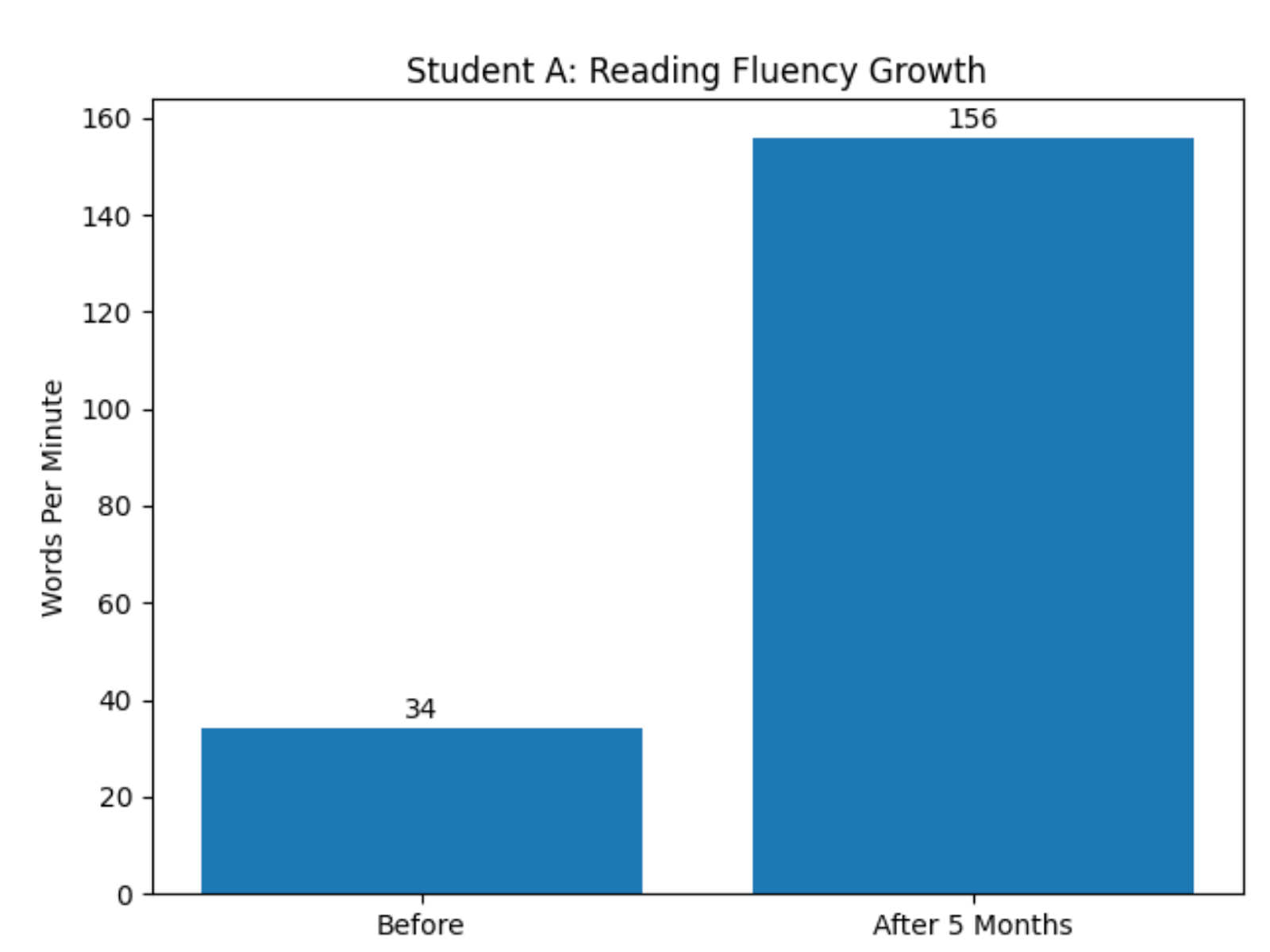
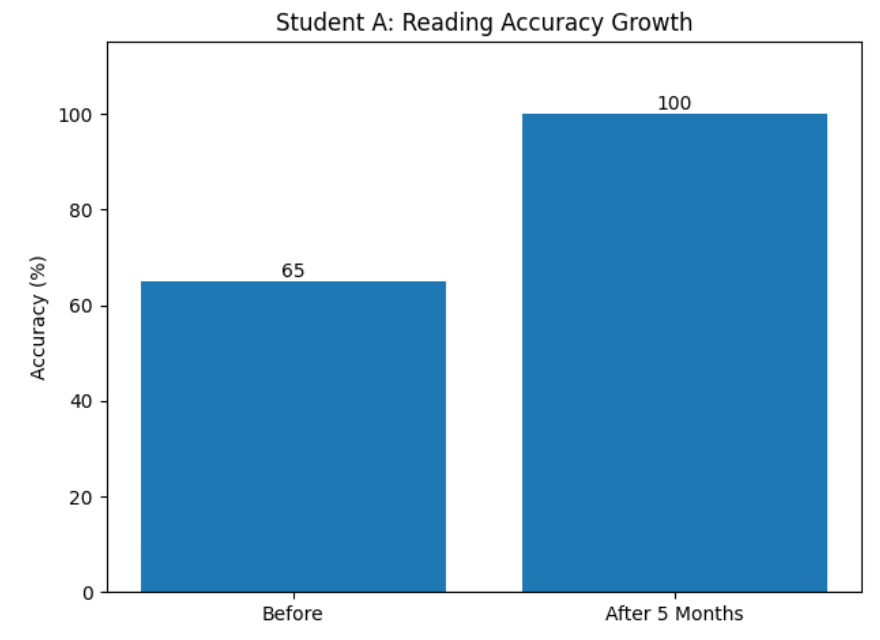
Student A
Before tutoring, Student A read slowly and inaccurately, managing 34 words per minute with 65 percent accuracy. He frequently guessed and required words to be supplied.
After five months of instruction, Student A read the next passage at 156 words per minute with 100 percent accuracy. His reading shifted from hesitant and effortful to confident and fluent as decoding became automatic.
Student B
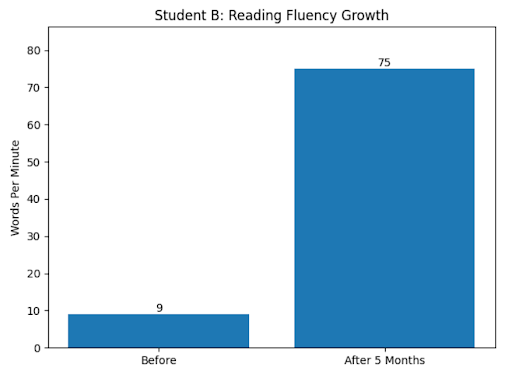
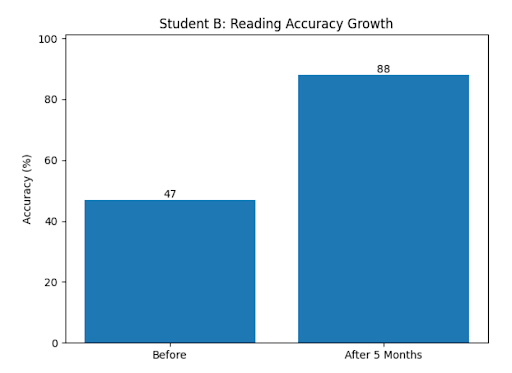
Student B began tutoring reading 9 words per minute with 47 percent accuracy, struggling on nearly every line of text.
After five months, fluency increased to 75 words per minute and accuracy rose to 88 percent. Reading became smoother, more confident, and far less error-prone as decoding replaced guessing.
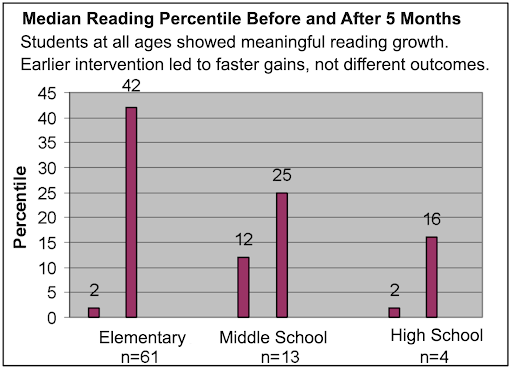
Does this approach work for secondary students, or only elementary students?
What results do you see across larger groups of students?
We also track outcomes across cohorts of students over time using standardized measures.
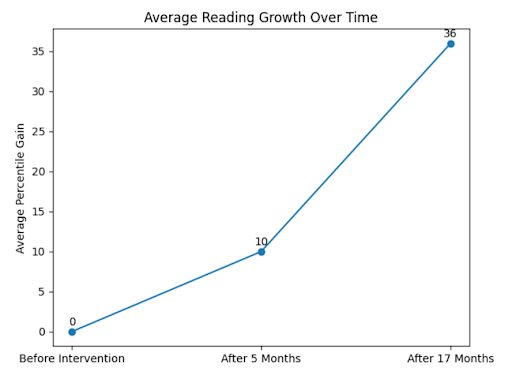
In one long-term pilot cohort:
After five months of instruction, students gained an average of 10 percentile points in reading performance. Nearly half of students who began with moderate or severe delays reached the average range.
After seventeen months, the average gain increased to 36 percentile points, with the majority of students reading at grade level.
What this graph shows
This graph shows the average improvement in reading performance for students during the first 17 months of structured instruction. Gains accumulate steadily over time as foundational reading skills become more accurate and automatic.
What happened after 29 months?
By 29 months, most students who had reached grade-level reading had exited the program. The remaining students had the most complex learning profiles and continued working toward mastery. Even within this group, average reading performance continued to improve, and most were reading at or near grade level. Those who required more time still made substantial progress that significantly changed their academic trajectory.
Do struggling readers really improve on state and classroom assessments?
Yes. When instruction targets the root causes of reading difficulty, improvements extend beyond tutoring sessions and show up on real academic measures, including state and school-based assessments.
Below is an example from a school-based Structured Literacy pilot using Orton–Gillingham–aligned instruction. Student performance was measured using the California State Test in English Language Arts.
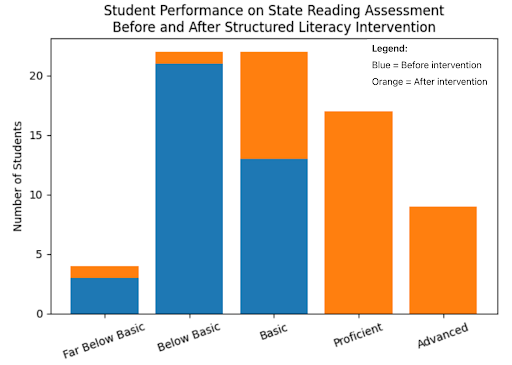
Students Show Significant Gains on State Reading Assessments
Before receiving Structured Literacy instruction, most students in this group were performing in the Far Below Basic or Below Basic ranges on the state reading assessment. After intervention, the majority of students moved into higher performance categories, with many reaching Basic, Proficient, or Advanced levels.
This shift matters because it shows that improvements in decoding, fluency, and reading efficiency transfer to classroom learning and standardized assessments. When students learn to read more accurately and automatically, they are better able to demonstrate their knowledge across school tasks and tests.
Does early intervention make a difference?
Yes. Early identification and explicit Orton–Gillingham instruction significantly improve long-term reading outcomes.
Across research and practice, the pattern is consistent. Students who receive explicit instruction earlier are more likely to move into the average reading range sooner and are better able to benefit from classroom instruction as academic demands increase.
Early, explicit instruction changes reading trajectories.
Can older students still make significant progress?
Yes. Middle school and high school students can make meaningful gains when they finally receive explicit, systematic instruction.
In one group of secondary students, median reading fluency increased by more than two grade levels in just five months. Reading comprehension also rose substantially, allowing students to access more complex text with confidence.
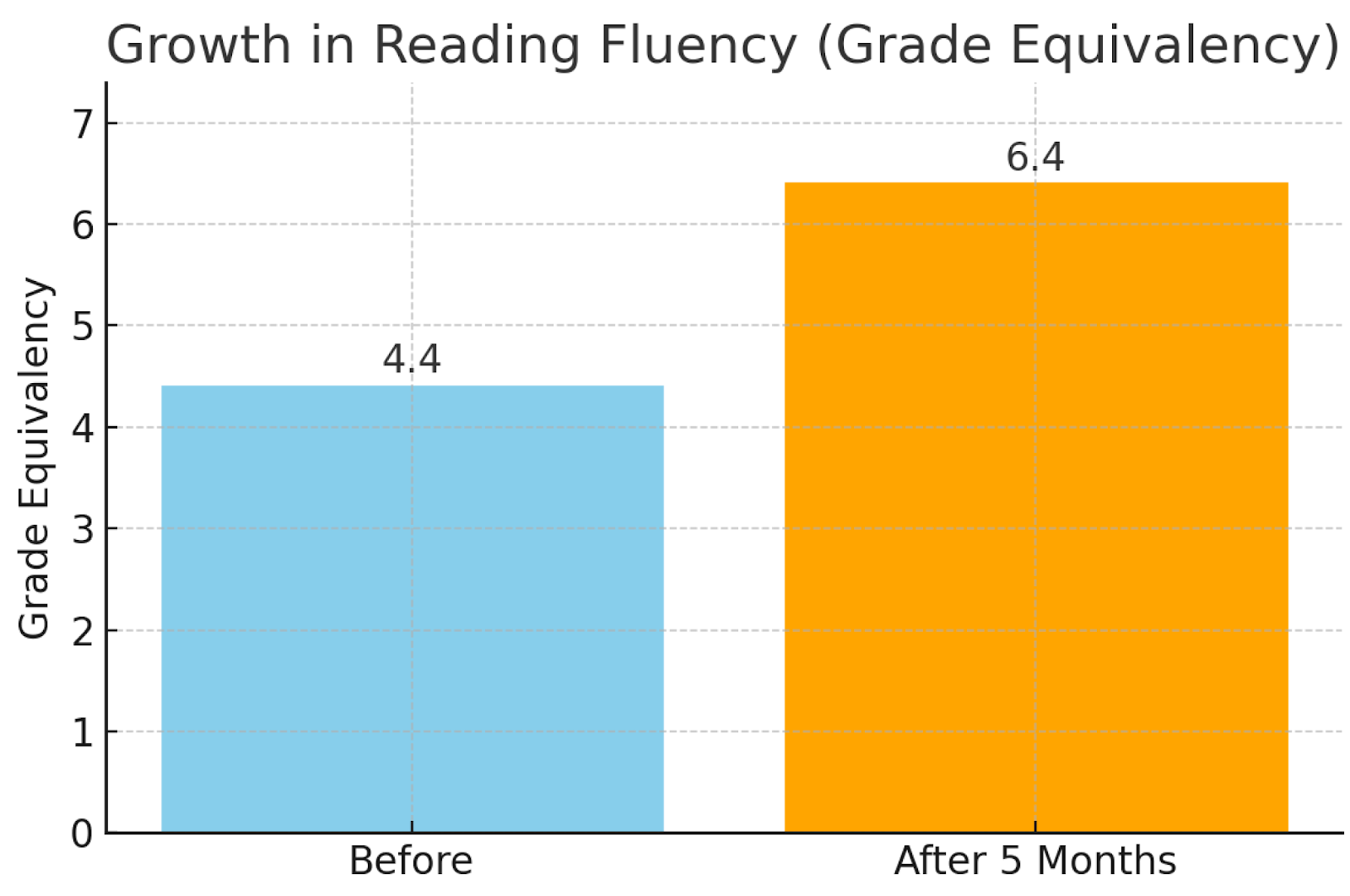
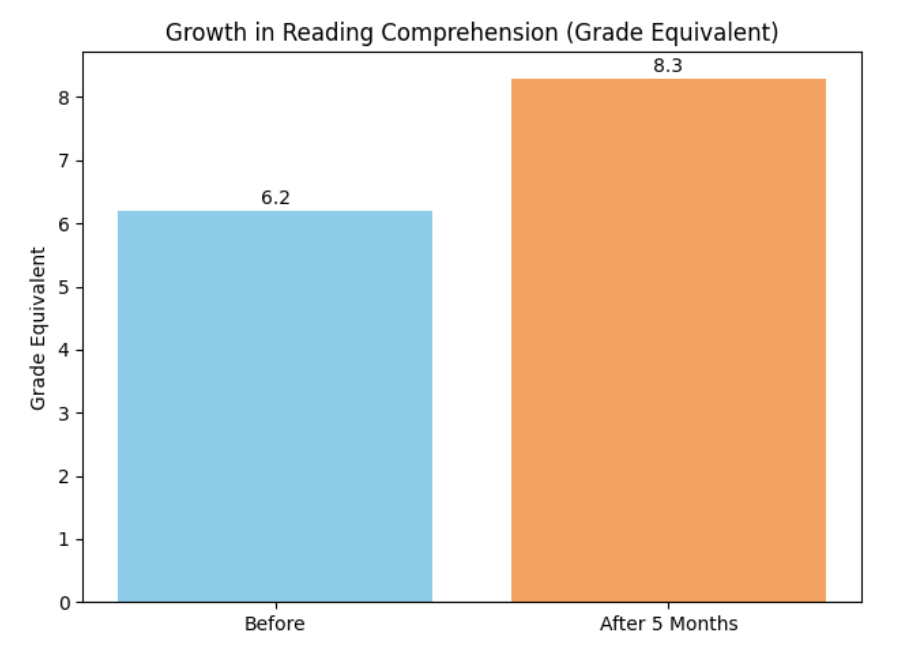
These results show that it is never too late to improve reading. The brain remains capable of building new reading pathways when instruction targets the root causes of difficulty.
Does every child catch up?
Most students make meaningful, lasting progress when instruction is delivered with fidelity and consistency. Some students reach grade level. Others may require more time, particularly if additional challenges such as attention difficulties or language delays are present.
Our goal is not temporary improvement or coping strategies. The goal is permanent change. When accurate decoding becomes automatic, reading becomes easier, confidence grows, and progress accelerates across subjects.
How do you measure progress so parents can see it?
We use multiple measures to track growth and ensure instruction is effective, including:
- Monthly standardized progress monitoring with Acadience
- An individually administered standardized reading test (GORT-5)
- Ongoing mastery checks embedded in instruction
- Regular review by program managers
Parents receive clear updates and can see evidence of progress over time.
What should I expect in the first few months?
What families notice in the first few months depends on a child’s age and starting point. Some students are still building early foundational skills, while others can already read, but need to replace inefficient strategies with accurate decoding so reading becomes more efficient and less effortful.
Across students, one of the most common early changes parents observe is increased confidence. Many children can tell when instruction is finally working for them. As reading begins to make more sense, frustration and anxiety often decrease.
Academic progress is not always as fast as families wish, especially for students who are significantly behind. However, growth is steady and measurable over time. Reading gains do not fade because Orton–Gillingham instruction changes how the brain processes written language by building new neural pathways.
Our experience has been that once a child begins to feel successful and hopeful, day to day life at school and at home often improves.
Strengths, Confidence, and Long-Term Growth
I understand dyslexia involves reading and spelling difficulty. Are there strengths associated with dyslexia?
Yes. Dyslexia is a specific learning difference that affects how written language is processed, not overall intelligence or potential. Many individuals with dyslexia demonstrate strengths in areas such as reasoning, problem solving, creativity, oral language, spatial thinking, and big-picture understanding.
Because dyslexia is an unexpected difficulty, children often develop alternative ways of thinking and approaching problems. When their reading and spelling difficulties are properly addressed, these strengths can fully emerge and support academic success.
It is important to understand that strengths do not cancel out reading difficulty. A child can be bright, articulate, and capable while still needing specialized reading instruction. When both needs are addressed, remediation and strengths together, children are positioned to thrive.
Why do children with dyslexia often develop resilience and persistence?
Many children with dyslexia spend years working harder than their peers just to keep up. When instruction finally matches how they learn, their experience of success changes dramatically.
Orton-Gillingham instruction carefully sequences skills so that students are not asked to perform tasks they are not yet prepared to do. Each step builds directly on the last. When a child is given work they can succeed at, confidence grows. Success becomes predictable rather than accidental.
Over time, this repeated experience of effort leading to success builds persistence, emotional resilience, and a willingness to take academic risks. These traits often extend beyond reading into writing, math, school participation, and self-advocacy.
How does effective reading instruction support confidence and emotional well-being?
When reading is effortful, unpredictable, or filled with errors, children often experience anxiety, frustration, or avoidance. They may begin to believe they are not smart or that school is not for them.
As decoding becomes accurate and automatic, reading feels different. Students can trust what they read. They are no longer guessing or relying on others to supply words. This shift reduces stress and allows children to focus on meaning rather than survival.
Parents often report that once reading begins to work, their child’s overall mood improves. Homework becomes less emotional. School resistance decreases. Confidence grows because the child feels capable again.
Can confidence really change even if my child is far behind?
Yes. Confidence does not depend on being caught up. It depends on feeling that progress is real and attainable.
Even when a child is significantly behind grade level, consistent, measurable growth sends a powerful message. The child learns that effort leads to improvement, and that reading difficulty is not a permanent failure.
Once hope is restored, many families notice meaningful changes in how their child approaches learning and daily life. Reading improvement may take time, but emotional relief often begins much earlier.
Does effective instruction create lasting change or will gains fade over time?
Effective reading instruction creates lasting change because it builds new, durable neural pathways for reading. When children learn how sounds connect to letters and how words are structured, they are not memorizing temporary strategies. They are developing an internal system for reading.
Because this instruction changes how the brain processes written language, gains do not disappear when tutoring stops. Skills become integrated, automatic, and available for continued learning.
This is why progress made through explicit, structured instruction is stable and transferable across subjects and grades.
What does long-term success look like for students with dyslexia?
Long-term success means more than reading faster. It means reading efficiently enough to access learning, express ideas, and engage fully in school.
When reading, spelling, and writing are supported through appropriate instruction, students can use their strengths without being held back by decoding difficulty. Many go on to succeed in advanced coursework, higher education, creative fields, and leadership roles. Their dyslexia no longer functions as a barrier to learning. Instead, it becomes one part of a learner’s profile, rather than the factor that defines or constrains academic and life success.
What kinds of strengths are commonly associated with dyslexia?
Dyslexia is often discussed only in terms of reading and spelling difficulty, but research and lived experience show a broader and more nuanced picture.
Because dyslexia is an unexpected difficulty in an otherwise capable learner, many children develop alternative ways of thinking, problem-solving, and understanding the world. These strengths are not caused by struggle alone, nor do they replace the need for effective reading instruction. Instead, they reflect a different cognitive profile that becomes more visible once reading barriers are properly addressed.
When children receive instruction that genuinely remediates decoding, spelling, and writing, two things tend to happen at the same time. Reading becomes less effortful and more automatic, and the child’s natural strengths have room to emerge and be used fully. Skills that were always present but overshadowed by frustration and effort can finally support learning, confidence, and long-term success.
Below are several strengths frequently observed in dyslexic learners, along with examples of how these strengths often show up in school, careers, and life.
Big-Picture Thinking
What this looks like:
Seeing patterns, connections, and overarching ideas rather than focusing only on isolated details.
Where this shows up:
Entrepreneurship, strategy, leadership, innovation, systems thinking
Illustrative example:
Richard Branson
Creative Problem Solving
What this looks like:
Approaching problems from unexpected angles, generating original ideas, and finding solutions others overlook.
Where this shows up:
Design, technology, innovation, engineering, the arts
Illustrative example:
Steve Jobs
Creative & Visual Thinking
What this looks like:
Strong visual-spatial reasoning and imaginative thinking that support invention, design, and original expression.
Where this shows up:
Animation, architecture, engineering, design, filmmaking
Illustrative example:
Walt Disney
Conceptual & Narrative Thinking
What this looks like:
A strong ability to understand meaning, story structure, cause-and-effect, and complex ideas when information is presented verbally or visually.
Where this shows up:
Storytelling, filmmaking, communication, big-concept work
Illustrative example:
Steven Spielberg
Empathy & Insight
What this looks like:Heightened awareness of others’ emotions, perspectives, and experiences, often paired with strong interpersonal insight and sensitivity.
Where this shows up:
Leadership, counseling, healthcare, education, advocacy, collaborative roles
Illustrative example:
Fred Rogers
Persistence & Resilience
What this looks like:
Sustained effort through challenge, willingness to keep trying after setbacks, and determination built through experience.
Where this shows up:
Athletics, writing, entrepreneurship, demanding professional paths
Illustrative examples:
Michael Jordan; J.K. Rowling
Important note for parents:
Every child is unique. Not every dyslexic learner will show every strength listed below. These examples are meant to broaden perspective and help families recognize possibilities, not to label or limit a child.
California’s K–2 Reading Screening Law
What Parents Need to Know About Your Child’s Screening Results
California now requires early reading screening in kindergarten through second grade. This law exists because reading difficulty does not usually resolve on its own, and the earlier a child receives the right instruction, the easier it is to close gaps and prevent long term academic and emotional consequences.
This section helps you understand what the screening results mean, what they do and do not tell you, and how to decide what steps to take next.
What is California’s K–2 Reading Screening Law?
California’s K–2 Reading Screening Law requires public schools to screen students in kindergarten, first grade, and second grade for early signs of reading difficulty. The screening focuses on foundational skills such as phonemic awareness, decoding, and early fluency because these skills strongly predict future reading success.
The purpose of the law is early identification. It is designed to flag children who may be at risk so they can receive support before reading gaps widen.
If my child met the benchmark, does that mean everything is fine?
Generally, yes.
If your child met the benchmark, it means they are currently on track to become a proficient reader by the end of third grade. Their current instruction is effectively supporting their reading development, and no additional intervention is typically needed at this time.
Continued monitoring is still important, but meeting the benchmark is a reassuring sign.
If my child scored below benchmark, should I be concerned?
Yes. A score below benchmark is meaningful, even if it is only slightly below.
A below benchmark score indicates that your child is not developing foundational reading skills at the expected rate with current classroom instruction. Research shows that children who score below benchmark have a significantly lower likelihood of reaching grade level reading without targeted, specialized instruction.
Small gaps in early reading skills tend to widen over time if the instruction does not change.
What does “well below benchmark” mean?
A well below benchmark score indicates a high level of risk for ongoing reading difficulty unless immediate and intensive intervention is provided.
Children in this range are unlikely to catch up through general classroom instruction alone. Research consistently shows that students who score well below benchmark in early grades have a low probability of reaching grade level reading by third grade unless they receive explicit, systematic intervention.
The purpose of the screening law is to identify “well below benchmark” and also “below benchmark” students as early as possible.
My child is very bright. Could the screening still be accurate?
Absolutely.
Early reading difficulty, including dyslexia, is not related to intelligence. Bright, articulate children often compensate in the early grades, which can temporarily mask underlying weaknesses in phonemic awareness and decoding.
The screening measures how efficiently your child processes sounds and connects them to print, not how smart they are. Many high potential children score below benchmark because these foundational skills are not developing as expected with typical classroom instruction, which puts children at risk for falling further behind unless instruction changes.
Will my child grow out of a low screening score?
No.
Reading difficulty improves with instruction, not with time. Children do not naturally grow out of weaknesses in phonemic awareness or decoding. Without targeted instruction, inefficient strategies such as guessing often become more ingrained, making reading harder rather than easier over time.
The law exists because waiting is far less effective than early intervention.
The teacher says my child is doing fine. Should I still take the screening seriously?
Yes.
Classroom performance can be misleading in early grades. Many reading activities rely on predictable texts, memorization, or strong listening comprehension. A child may appear to be doing fine while still struggling with the foundational skills measured by the screening.
The screening provides objective data about early reading development that may not be obvious through classroom observation alone.
Is school intervention enough?
Sometimes, but not always.
School intervention varies widely. Key questions to ask include:
- Is the intervention based on explicit, systematic instruction?
- Is it taught in a small group or one on one?
- Is progress monitoring frequent enough to ensure it is working?
If your child’s screening scores do not improve with school intervention, more intensive instruction is needed. The screening should be repeated regularly so families can see whether the intervention is effective.
What do the screening scores tell me about the future?
Screening scores estimate likelihood, not destiny.
In general:
- Children who meet the benchmark have a high likelihood of becoming proficient readers with current instruction.
- Children below benchmark have a substantially lower likelihood unless instruction changes.
- Children well below benchmark have a low likelihood without intensive, specialized intervention.
These probabilities are exactly why early screening and early action matter.
What should I do if my child scored below benchmark?
A below-benchmark score means your child needs instruction that is more explicit and more targeted than general classroom teaching. Schools often organize reading support using a tiered system, and understanding these tiers can help you advocate for your child.
Tier 1
This is regular classroom instruction provided to all students. When a child scores below benchmark, Tier 1 instruction alone is usually not enough to close gaps.
Tier 2
Tier 2 typically involves small-group intervention in addition to classroom instruction. It should be more explicit and focused on foundational skills. Progress should be monitored regularly to determine whether the intervention is working.
Tier 3
Tier 3 is the most intensive level of support. It is designed for students who continue to struggle despite Tier 2 intervention. Instruction is more individualized, more frequent, and more systematic. Tier 3 does not automatically mean special education; it means a higher level of instructional intensity.
An important part of the tiered system is progress monitoring. If a child is not making meaningful progress, instruction should become more explicit and more intensive. Waiting without adjusting instruction allows reading gaps to widen.
Parents who understand the tiered system are better equipped to ask important questions, such as:
- What specific skills are being taught?
- How often is progress monitored?
- What will change if my child does not improve?
Early, well-matched instruction gives children the best chance to catch up before reading difficulties become entrenched.
Every kid CAN read.
Let's prove it together.
Start with a free online reading screening. No commitment, no pressure — just answers and a clear path forward.